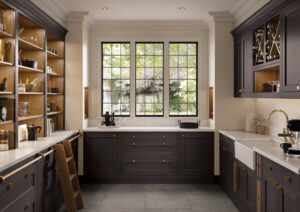
Nearly every kitchen conversation we have starts in the same place. Someone has seen a shaker kitchen they like and an in-frame kitchen they love, and they want to know what the difference actually is — and whether it is worth what it costs.
It is a fair question, and the answer is not as simple as one being posher than the other. They are two different ways of building a door, and they behave differently in a room. Here is what thirty years at the bench has taught us about choosing between them.
What a shaker door actually is
A shaker door is five pieces of timber: four rails forming a frame, and a flat panel sitting inside them. That is the whole idea. It came out of a religious community that distrusted ornament, and it has outlasted every fashion since because there is nothing on it to go out of date.
What varies — and what you are really choosing between when you look at shaker ranges — is the width of that frame and the profile where it meets the panel. A classic shaker has a generous frame and a square edge. A narrow shaker, like Aldana or Dawson, slims the frame down and reads noticeably more contemporary. A micro shaker such as Aylesford takes it further again, to the point where the frame is more of a suggestion than a feature. Florence adds a bead where frame meets panel, which pulls the whole thing back towards the traditional.
Same family of door. Four quite different rooms.
What in-frame means
In-frame is not about the door at all. It is about where the door sits.
On a standard kitchen, the doors sit on the front of the cabinet and cover it. On a true in-frame kitchen, like Belgravia, every door and drawer is set inside a solid timber frame fixed to the cabinet, so the frame is visible all the way around each opening. It is how freestanding furniture has been built for centuries, and it is why an in-frame kitchen reads as furniture rather than as units.
The catch is tolerance. When a door sits on top of a cabinet, a millimetre here or there disappears. When it sits inside a frame, every gap is on show, and it has to be consistent along a ten-foot run. That is time at the bench, and time is what you are paying for.
In-frame effect: the honest middle
In-frame effect ranges — Arrington and Ellesmere are the ones we reach for most — are engineered to produce the shadow line and the sense of depth that in-frame gives you, without the frame construction underneath.
We will be straight with you: from three feet away in a finished room, most people cannot tell. Standing at the cabinet with the door open, anyone can. Whether that matters is a genuine question about you rather than about the kitchen. If you are the sort of person who will know, you will know, and you should buy the true in-frame. If you are not, in-frame effect will give you the look you fell for and leave money on the table for a better worktop.
How each one reads in a room
Light is the thing nobody mentions. In-frame throws a real shadow line around every opening, and shadow needs light to exist. In a bright, south-facing room with good ceiling height, that detail sings. In a low, north-facing room, the same detail can read as busy and closed-in, and a flat-panelled narrow shaker will feel calmer and larger.
Ceiling height matters more than floor area. In-frame carries vertical detail. Under a low ceiling that detail has nowhere to go.
Age of the house is a real signal. In-frame in a period house looks like it was always there. In a new build with square openings and flat plaster, it can look like it is trying. Narrow and micro shaker sit far more naturally in contemporary architecture — which is exactly why those profiles exist.
The cost logic, plainly
Three things push in-frame above shaker, and none of them is margin.
There is more material, because the frame is additional timber on every cabinet. There is more machining, because that frame has to be cut, jointed and finished to a tighter standard than a door face. And there is more fitting time, because hanging a door inside a frame so it sits true — and still sits true in five years — takes longer than hanging one on the front.
In-frame effect removes most of the first and second and a good deal of the third. That is the entire reason it exists, and it is why we quote it so often.
Longevity and living with it
Both styles last. Both are painted timber, both can be repainted, and both carry the same product warranties across our collection.
Two practical differences show up over years rather than months. A shaker panel has a rebate that catches dust and needs a cloth run along it; in-frame adds more of those edges, so there is simply more to wipe. And if a door gets damaged a decade on, a shaker front is a straightforward replacement, while an in-frame front has to be fitted to an existing opening — more of a job, though far from impossible.
Neither of those should decide anything. They are just worth knowing before you are living with it.
How to decide
If the house is old, the ceilings are high and the room takes good light, in-frame will repay you and you will never tire of it.
If the house is newer, the ceilings are standard or the light is limited, a narrow or micro shaker will suit the room better — and it will not look like a compromise, because it is not one.
And if your heart is set on in-frame but the budget is doing arithmetic, take the in-frame effect and put the difference into the worktop, the hardware and the storage. That is the trade we would make ourselves.
The honest answer, though, is that this is not a decision to make on a screen. Shadow lines do not photograph. Come and see the shaker ranges and the in-frame ranges beside each other in our Rooskey showroom, ten minutes from Carrick-on-Shannon on the Tarmonbarry road. Visits are by appointment Monday to Saturday so you get our full attention, and the consultation is free. Get in touch and we will put the kettle on.